
‘Amar bari, amar jibon’
'My home, my life' - Developing living environments for Bangladeshi elders
Launched on the Bangladeshi Independence Day on Saturday, 26 March 2022, ‘Amar bari, amar jibon’ (My home, my life): developing living environments for Bangladeshi elders, was a pioneering 36-month research project that focused on the entrenched housing and health inequalities of Bangladeshi elders (‘probin’ in Bangla) in East London.
We are now pleased to share the final report publication, launched at the House of Lords by Lord Best in February 2026, marking the culmination of the coproduced study on the housing experiences, needs and aspirations of older Bangladeshi communities in four East London boroughs, with evidence-led recommendations for policy, recognition and action.
Bengali version:
Further information
Final Report
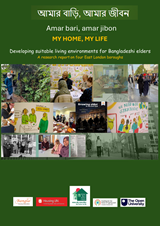 Funded by the Vivensa Foundation, this 30-month joint project with The Open University, Bangla Housing Association, and Housing LIN examined housing experiences of the Bangladeshi ‘probin’ community across four East London boroughs.
Through interviews with 76 older adults, eight families, and advisory groups of local residents and professionals, the study explored needs, aspirations, and challenges related to housing, health, and neighbourhoods.
Findings reveal overcrowding, poor housing quality, limited awareness of options, and constrained choices near community networks. Recommendations for policymakers and service providers focus on three themes:
- evidence of ethnic housing inequities
- recognition of systemic disparities
- and action to address discriminatory systems.
Read the report and executive summary here
Aims & Objectives of the research
This study explored values, perceptions and aspirations regarding current and future housing and question how age, housing and living arrangements interact and affect health and quality of life of the Bangladeshi ‘probin’ community in Hackney, Newham and Tower Hamlets in East London.
The project embraced themes of culture, equity, diversity, and inclusion contributing to a better understanding of the everyday life, health and wellbeing of the older Bangladeshi community in mainstream and specialist housing. Drawing on their experiences and needs, it sets out what future housing options might look like and help inform how to enable a wider range of housing choices.
It further investigated:
- how experiences of living environments vary by sex, age, and health related conditions, living arrangements, tenure, and socio-economic status
- how current circumstances enable and constrain health and wellbeing
- the advantages/disadvantages, experiences, and preferences regarding living in different circumstances: a multi-generational family household, or alone, or in a couple
- how Bangladeshi ‘probin’ respond to and adapt their living environment when their housing no longer meets their needs
- capture sources of informal and formal advice and support that older Bangladeshi’s draw on to sustain their wellbeing over time; and
- shared findings on the perspectives of housing, health and social care providers about issues facing Bangladeshi ‘probin’ and ways of addressing these.
Methodology
Our partnership and overall approach to conducting this study was embedded in participatory and community research traditions reinforced by inclusive and collaborative ways of working.
The project aimed to conduct:
- Eighty in-depth interviews with Bangladeshi elders aged 50 and over living in multigenerational households, communal extra care settings and/or as a couple in East London boroughs of Hackney, Tower Hamlets and Newham – to gather their perspectives on what they value about their ‘ways of living’ and ‘what they would like to change’.
- Ten focus groups will be held separately with families of probin to understand the experiences of and factors influencing multigenerational living.
- Twenty-five semi-structured interviews with key housing, health, social care and design professionals drawn from across the three boroughs including at metropolitan and national levels will also be completed – to enable gathering information about local housing and housing-related provision and practice including surfacing key issues in developing living environments for older people from minority ethnic groups.
Active inclusive involvement of communities (‘Research publics’) was sought in the following ways:
- Community Co-researchers includes 6 people aged 18 years and above (both women and men) appointed to a paid role, jointly recruited by BHA and OU and trained in research ethics and interviewing by the academic team to conduct interviews with Bangladeshi probin in Sylheti, Bengali and English as required.
- Bangla Research Advisory group (BRAG) comprising 8 community members in place at outset of the study to include both women and men from across the three East London Boroughs. Supported by BHA and OU, BRAG members will be enabled to fully engage and contribute comfortably to different aspects of the research - from shaping the research questions to working with Practitioner Advisory Group to consider dissemination of findings and recommendations and influencing practice and policy.
- Practitioner advisory group (PAG) comprising of 10-12 local service providers, practitioners, policy makers and academics recruited to the study and in place at the outset. They will advise on local and national issues relevant to the research to explore with Bangladeshi probin and through professional interviews and support dissemination, accessibility and usability of findings in practice and policy
Partners Information
 The Open University’s mission since 1969 is, ‘to be open to people, places, methods and ideas and this means that a commitment to equality is embedded in all that we do. We celebrate diversity and the strengths that it brings, we challenge under-representation and differences in outcomes.’
Actively promoting educational opportunity and social justice, the Open University has a vibrant research community and a stellar reputation for research excellence. The Faculty of Wellbeing, Education and Language Studies, where the OU team is located, has a dynamic research culture and environment with a strong tradition in methodological innovation and participatory research. For more information visit: https://wels.open.ac.uk/ (opens new window)
 Bangla Housing Association (BHA) was formed to support the Bangladeshi community that was experiencing housing problems in the London Borough of Hackney. BHA have since extended their remit and now support and house people from wider communities in the London Boroughs of Hackney, Islington and Waltham Forest. BHA’s mission is to provide decent, affordable homes and support services for those in needs in the local BME and the wider community. For more information visit: https://www.banglaha.org.uk/about (opens new window)
 The Housing LIN is the 'go to' sharing network for anyone working in housing, health and social care promoting solutions that enable everyone to live well in good quality housing. The network provides market insight and intelligence on latest funding, research, policy and practice to inspire better housing and care choices through its free knowledge and information sharing activities and consultancy business. For more information visit https://www.housinglin.org.uk/
 This research project is supported by The Vivensa Foundation through the "Building and delivering suitable living environments and communities for an ageing population" grant scheme.
For more information visit: www.vivensafoundation.org.uk (opens new window)
News update
Amar Bari Amar Jibon Newsletter
From March 2023, the Amar Bari Amar Jibon team produced a series of newsletter providing a round-up of the project’s activities. They are availble here for reference: March - April 2025 Newsletter (opens new window); January - February 2025 Newsletter (opens new window); November & December 2024 Newsletter (opens new window); September 2024 Newsletter (opens new window); June, July & August 2024 newsletter (opens new window); April - May 2024 newsletter (opens new window); February - March 2024 newsletter (opens new window); November 2023 newsletter (opens new window); October 2023 newsletter (opens new window); September 2023 newsletter (opens new window); August 2023 newsletter (opens new window); July 2023 newsletter (opens new window); June 2023 newsletter (opens new window); May 2023 newsletter (opens new window); April 2023 newsletter (opens new window); March 2023 newsletter (opens new window)
Related news items:
Other useful information
Throughout the course of this programme, we shared various relevant resources here. In the meantime, on a range of more general resources on housing and diversity in later life, visit this dedicated page on the Housing LIN website.
If you would like to propose specific resources to be included on this page, please send these for our consideration at: info@housinglin.org.uk
Contact
For enquiries relating to this research, contact:
- For more information, please email manik.deepak-gopinath@open.ac.uk
- For all PR enquires, please email comms@housinglin.org.uk
Acknowledgments
Funded by The Vivensa Foundation through the ‘Building and delivering suitable living environments and communities for an ageing population’ grant, the project is led by The Open University (OU) in partnership with the Bangla Housing Association (BHA) and the Housing LIN (Learning and Improvement Network).