
Placemaking for an Ageing Population in Wales
As Wales’s population ages, the way we design our buildings, streets and neighbourhoods has a crucial role to play in tackling loneliness and supporting social connection– critical issues for older people. Placemaking is not just about providing homes, but about creating places that enable people of all ages to meet, interact and thrive. The Placemaking Wales Charter (opens new window) – developed by DCFW, Welsh Government and the Placemaking Wales Partnership in 2020 - provides a strong framework for achieving this.
People and Community
Loneliness and isolation are significant challenges, particularly for older people, as recognised by the Welsh Government in its Connected Communities (opens new window) strategy, and the design of the built environment can either reinforce or reduce these risks. The Placemaking Wales Charter places people and community at the heart of the planning, design and management of places, making it the starting point for all placemaking decision.
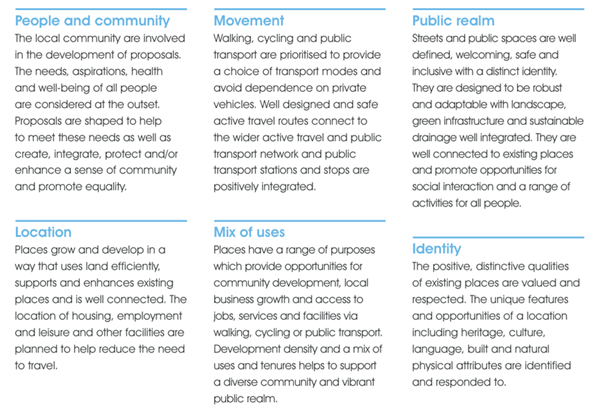
The six principles of the Placemaking Wales Charter – Developed to support the creation of high-quality places across Wales for the benefit of communities.
Designing for older people begins with understanding the needs of existing and future residents, including mobility, comfort, safety and opportunities to socialise. Developments should provide a range of shared spaces that support different levels of interaction. Alongside residents’ lounges or shared facilities, incidental spaces such as entrance lobbies, generous circulation areas and shared gardens can encourage informal, everyday encounters that help build a sense of belonging.
Location and Movement
Location plays a critical role in preventing isolation. Homes for older people should be integrated within the heart of existing communities, close to shops, services, healthcare and public transport. Building housing within town centres allows residents to remain connected to daily life, supporting independence and intergenerational interaction rather than creating isolated, single-use developments.
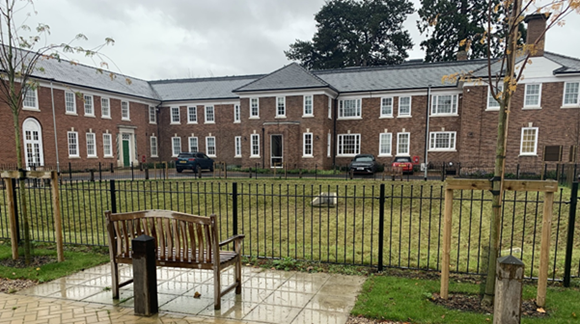
Neuadd Maldwyn, Welshpool – A refurbished building delivering 66 homes for older people within walking distance of the town centre.
Movement networks are equally important. Streets, paths and internal routes should be safe, accessible and comfortable, encouraging people to move around confidently and regularly. Clear wayfinding, good lighting and opportunities to stop and rest all support greater use of public spaces and increase opportunities for social contact.
Mix of Uses, Public Realm and Identity
A mix of uses strengthens social life by giving people reasons to be out and about throughout the day. Locating homes near community facilities, services and shared amenities creates natural meeting points and supports regular social interaction. The design of the public realm also plays a key role. Streets and spaces that support a range of activities — from children playing to people sitting, talking and watching — help create welcoming, inclusive places for all generations.
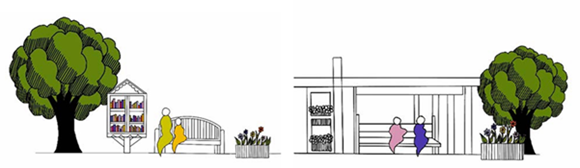
Careful consideration and arrangement of everyday neighbourhood elements can help create welcoming public spaces that support social interaction. Illustration: © Design Commission for Wales
Identity is also important, particularly for people living with dementia. Legible layouts and recognisable landmarks help create familiar environments, supporting orientation, wayfinding and the confidence to continue engaging with surroundings.
Designing for All Ages and Supporting Better Outcomes
The 8–80 concept (opens new window) offers a useful lens through which to reflect on placemaking: if a place works well for an eight-year-old and an eighty-year-old, it will work better for everyone. Designing safe, sociable and legible environments for these age groups creates places that support people across the life course.
At the Design Commission for Wales, we support the incorporation of these considerations through our Client Support (opens new window), Training & CPD (opens new window), and Design Review (opens new window) services. By working with clients, designers and local authorities early in the design process, and providing independent, expert feedback on emerging proposals, we help ensure new development responds positively to the Placemaking Wales Charter and delivers high-quality design that supports social connection and well-being.
Max was a keynote speaker at the Housing LIN Cymru Symposium, Making Wales a Great Place to Grow Old, on 4 November 2025 at Clwyd Alyn Housing Association’s extra care scheme, Neuadd Maldwyn, in Welshpool. His presentation and further information about the event can be found here.
If you would like to find out more about how the Design Commission for Wales can support your project, please get in touch with us at connect@dcfw.org.
And for details about Housing LIN Cymru, click here.
Comments
Add your comment