
Fun is not the opposite of professionalism – it’s the foundation of wellbeing
Thank you to the Housing LIN for kindly hosting our Dementia Friendly Fun webinar for the Dementia and Housing Working Group (DHWG). As the only national group focused on housing and dementia, the DHWG aims to promote and influence the contribution of the housing sector in improving the health, wellbeing and quality of life for people living with dementia.
Having been involved in dementia, housing, healthcare and technology for more than two decades, I’ve found that “fun” has not always been a priority in dementia care. Rather we often focus on risk, decline and care and whilst extremely important, rarely do we talk about joy.
We all know the stats - 1 in 3 people born today will go on to develop dementia and it’s still the UK’s biggest killer, ahead of heart and respiratory diseases and strokes. But you can live well with dementia and that’s what this webinar is all about.
Why dementia-friendly fun matters
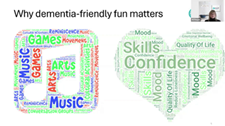 There is a growing body of research showing that dementia friendly fun can have a positive impact on wellbeing, confidence and quality of life, helping people stay socially connected, reduce loneliness and support emotional wellbeing.
Activities such as music, games, arts, reminiscence, movement, conversation groups and cultural activities can lead to improvements in thinking skills, mood and day-to-day functioning and it may even help slow cognitive decline.
So it’s all about creating moments of joy and connection but they’ve got to be person-centred - based on someone’s interests, strengths, routines and personality, rather than simply focusing on the diagnosis itself.
The role of housing
I’m always amazed when we get asked why is housing important as dementia is often discussed through a health and care lens. Everyone lives somewhere – whether their own home, rented home, care home or hospital. So why on earth shouldn’t it be a critical part of the conversation?
This webinar explored how housing environments could be designed not just around safety, but around fun, connection and moments of light, highlighting the importance of dementia friendly spaces that foster joy, belonging and greater understanding for everyone.
Enthusiasm has no expiration date: The Importance of planning for activity in age-inclusive design
Our first speaker was Dr Cate Pemble, Research Fellow, Dementia and Ageing, University of Stirling. She gave a heartfelt personal example of her family experience to illustrate her work. The year her nana died, her grandad took up growing award-winning fuchsias. As he grew older, he often said he could never move into residential care because he loved gardening too much - an assumption that overlooked how adaptable care settings can be, particularly when it comes to supporting hobbies like gardening.
Designing homes for healthy cognitive ageing
Her work on the Designing Homes for Healthy Cognitive Ageing (DesHCA (opens new window)) project explored how housing design can help people remain in their own homes and communities for longer, with scalable approaches to easing pressure on ageing systems. A key finding was a widespread gap in understanding what older people actually want from later life, with many viewing ageing as something that happens to “others,” a perception that persisted even among people in their 90s. Participants consistently emphasised the desire for flexible homes that could evolve with changing needs, finances, and interests, rather than being defined by decline or limitation.
Would I live here?
She concluded that a key question for anyone designing homes for the future is, “Would I live here?” After all, these are the environments we may one day inhabit ourselves. If a design doesn’t work for you or your friends, you’ve probably missed a trick.
How a children's detective novel explores themes of dementia within the trappings of a classic detective novel
Next up was Mario Ambrosi, Director of Communications and Marketing, Anchor. He was inspired to write a children’s book (opens new window) after his uncle was diagnosed with dementia, noticing how his own children could see something had changed in him but struggled to understand why. As someone who used to tell jokes repeatedly, his shifting behaviour prompted difficult questions and he wanted a way to explain what was happening without resorting to a clinical or frightening explanation.
A story told through curiosity and care
From this came the idea of a children’s detective story, featuring 12 year old Scarlett, who sets out to understand why her grandmother is confused and distressed. Through Scarlett’s journey, the story explores dementia through the lens of curiosity, listening and person-centred care, framing it as detective work rather than something to “solve” or cure.
Giving children the language to understand dementia
The narrative was shaped through conversations with people living with dementia, experts and families, with a strong emphasis on honesty while remaining accessible to children. Since its publication in July 2025, he has spoken to around 1,000 children, finding that many already encounter dementia in their own families but often lack the language to talk about it. The book aims to provide that language, encouraging openness, curiosity and understanding, with royalties donated to Dementia UK.
Developing a dementia strategy with fun at the heart
Asa Johnson, National Resident Experience Manager, Anchor, gave us another personal story about his Nanny Pat who lived with dementia. She had rich hobbies but as a private person, the thought of attending a coffee morning was her idea of hell. Her experience highlighted a central theme of his reflection: the importance of truly understanding the person behind the condition, not just the diagnosis.
A strategy built around personalised dementia care
Within the organisation’s 121 care homes, he launched their new dementia strategy in November 2025 which introduced specialist roles, including dementia coaches, to strengthen personalised support. At its heart is the belief that fun is not an optional extra but a fundamental part of high quality care, alongside safety, clinical needs and routine. The strategy emphasises emotional wellbeing, life stories, and personalised approaches that focus on what people can do rather than what they cannot, alongside creative, sensory and cultural experiences that bring joy, connection and spontaneity into everyday life.
Joy doesn’t run to a schedule
Developing colleagues is key and it’s important to understand that joy doesn’t run to a schedule. He concluded that fun isn’t an optional extra and they are not supporting people to live, they are supporting people to live well.
How being mistaken for a landlady inspired a pub themed space
Our final speaker was Joy Sumner, Care Home Manager, The Watermill, a Housing 21 care home in Walsall. With 36 years’ experience in care home and day care settings, she described The Watermill, a specialist residential home for people aged 65+ living with dementia. The home, which achieved an Outstanding CQC rating in 2019 that has been maintained, is organised into four “houses,” with ten residents living in each.
Creating spaces that reflect real lives
Since opening in 2011, the home has taken a creative, person-centred approach to using space, transforming previously unused rooms into familiar, meaningful environments shaped by residents’ lives and identities. One resident who believed he was “back at the pub,” alongside a former landlady, inspired the creation of a fully functioning pub space - funded and built by staff in their own time - where residents can enjoy afternoons of favourite drinks, quizzes, dominoes and darts.
Everyday environments designed for joy and connection
Other spaces include a reminiscence room filled with familiar sights and sensory objects, a cinema with handmade touches, a retro hair salon for pampering, a shop that supports a sense of purpose, and a 1960s-style diner created during COVID through staff-led fundraising and events. Together, these spaces reflect a commitment to creativity, familiarity and joy, bringing everyday moments of fun into dementia care.
A final question to drive action
We concluded the webinar with one final question – What is one thing everyone should do after this webinar to help people affected by dementia, live well through more fun?
Designing the life we’d want for ourselves
Cate – "The lesson is to remember it will be you, or someone you love, at some point. The question is not how to avoid it, but how to make sure you can still live the life you want as you get older, and to assume others want that too and act appropriately."
Building understanding across generations
Mario – "Obviously buy the book! Intergenerational stuff is so important for me and I think that anything we can do to encourage children to capture stories and life histories of older people and loved ones builds understanding and this is the foundation of everything."
Prioritising fun and everyday joy
Asa – "It’s about making sure we prioritise fun and that we make sure people have permission to have fun. Let’s make sure every day is filled with moments of joy."
Creativity, listening and low cost impact
Joy – "Be creative and listen to what people want - remember it doesn’t have to cost much. It may take time, but when the passion is there, the financial cost is minimal. It delivers improved wellbeing, stronger social inclusion and above all else, fun."
Thank you to all our fantastic speakers and to the Housing LIN for hosting us. If you’d like to get involved in the DHWG, visit this page.
The Housing LIN is proud to host the Dementia and Housing Working Group webpages. You can access the latest DHWG resources here and watch the Dementia Friendly Fun webinar recording here.
Comments
Add your comment