
Future-Ready Homes
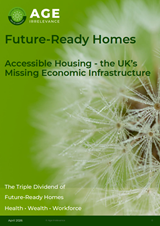
Age Irrelevance's Future Homes report demonstrates how a new Housing Strategy can play a pivotal role in shaping the UK’s future economy. The report sets out a practical, economically sound blueprint for housebuilders, governments and investors.
The report also includes a newly developed, five-point ‘100-Year Life Test’ to help policymakers, planners and developers assess whether new homes will remain fit for purpose over time.
THE TRIPLE DIVIDEND FOR THE UK
The report identifies a clear economic upside from aligning housing with demographic reality – a Triple Dividend:
- Health: reduce falls, NHS intervention and support independence
- Wealth: support stronger local economies and more resilient housing assets
- Workforce: enable extended working lives and retention of experienced talent
Even modest improvements in workforce participation among over-50s could unlock substantial economic value, while reducing demand on health and care systems.
Homes and communities built to support ageing in place generate a triple dividend: they fuel local economies, anchor social resilience, and reduce long-term demand on health and care systems.
ECONOMIC OPPORTUNITY FOR HOUSEBUILDERS
The report makes a strong commercial and strategic case for the sector:
- Designing homes that work across the life course supports longer working lives and workforce stability
- Accessible and adaptable homes reduce future retrofit costs and enhance asset value
- Meeting evolving demographic demand opens new and expanding markets
Kay Allen OBE, Founder of Age Irrelevance, said:
“Housebuilders have a real opportunity to lead here,” said “By embedding inclusive design into mainstream housing, the sector can future-proof its product, strengthen its value proposition, and play a central role in supporting economic growth. Think of it as building a home for your future self and what you will need at different stages of life”
ALIGNING HOUSING WITH ECONOMIC STRATEGY
Age Irrelevance calls for a more integrated approach that connects housing, workforce and health policy.
The report outlines practical steps to accelerate progress:
- Accessible and adaptable standards the default for new homes
- Fiscal incentives to support forward-looking developments
- Embedding future-ready design into planning and public land use
- Making the link between housing and workforce participation
Kate Nash OBE, an Ambassador for Age Irrelevance, said:
“We cannot keep building homes for an imaginary ‘average’ person while ignoring the reality of ageing and disability. Accessibility isn’t an add-on - it’s the foundation of a credible UK strategy for living and ageing well.”
A PLATFORM FOR COLLABORATION AND GROWTH
The report positions this agenda as a shared opportunity across:
- Developers and investors
- Local authorities and planners
- Central government and policymakers
- Health and social care systems
“This is about building homes that support how people live, work and contribute over longer lives,” said Allen. “The reality is many people will have to work for longer. The economy will push up the state pension age - that means staying in homes for longer, connected to places of work. We need housebuilders to be at the forefront of change not lagging behind”
Jeremy Porteus, Chief Executive of Housing LIN and an Ambassador for Age Irrelevance, added:
“To deliver this approach we need a genuine collaboration between planners, developers and policy makers to support a UK wide strategy. We need to champion the simple but transformative idea that inclusive housing is fundamental to healthy ageing.”