
A lifeline not a luxury: Delivering accessible homes for people with MND
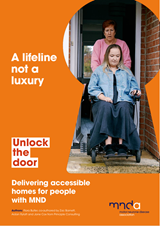
This Motor Neurone Disease (MND) Association report shows that Disabled Facilities Grant (DFG) delivery is a postcode lottery, impacted by unacceptably long wait times, unfair and inconsistent means testing, and variable approaches to the application of the means test and grant levels. It explains that these issues prevent many people with MND from making urgently required adaptations to their homes, putting them and their carers at risk of worse health outcomes, avoidable accidents and a drastically reduced quality of life.
The report also addresses the ongoing failure to build new accessible housing, which is needed to ensure the housing stock better matches the accessibility needs of the population as a whole.
It points out that currently only 1.4% of houses built between 2020 and 2030 in England will be suitable for a wheelchair user. And despite previous government commitments to take action, there is still no legally required proportion of housing that must be built to be fully habitable by wheelchair users.
Accompanying the report, the MND Association have launched a campaign, Unlock the Door (opens new window), that calls on local authorities in England, Wales, and the Northern Ireland Housing Executive to:
- Implement formal fast-track processes for people with MND to access DFGs.
- Waive the means test for adaptations of all sizes for people with progressive, life-limiting conditions such as MND.
- Increase the mandatory DFG cap, which hasn’t changed since 2008, in line with inflation.